

My Story of Becoming a Singing and Acting Voice Specialist
I studied singing and theater voice pedagogy, held up swooning sopranos in cadaver labs, observed in some of the best voice otolaryngology and speech language pathology clinics in the world so that I could help my clients perform every day without losing their voices.
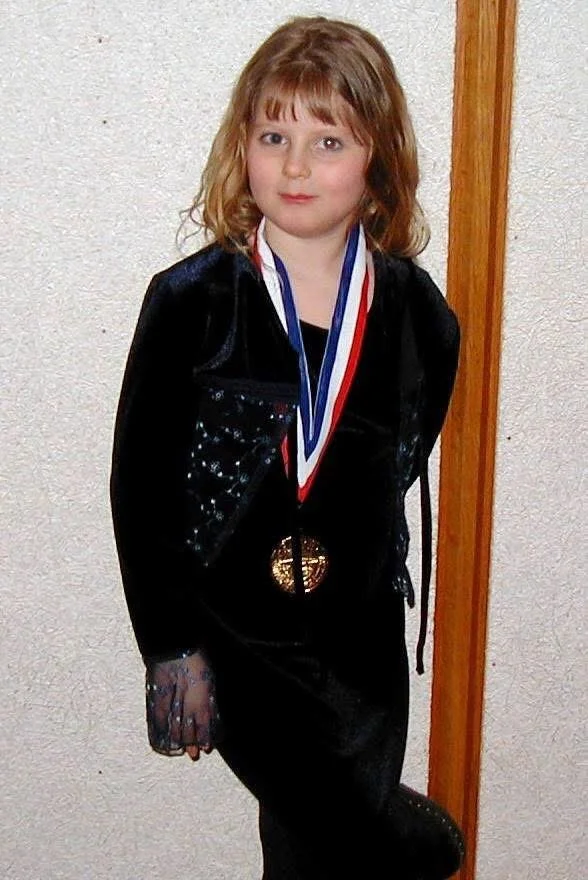
I began performing regularly when I was about four years old.
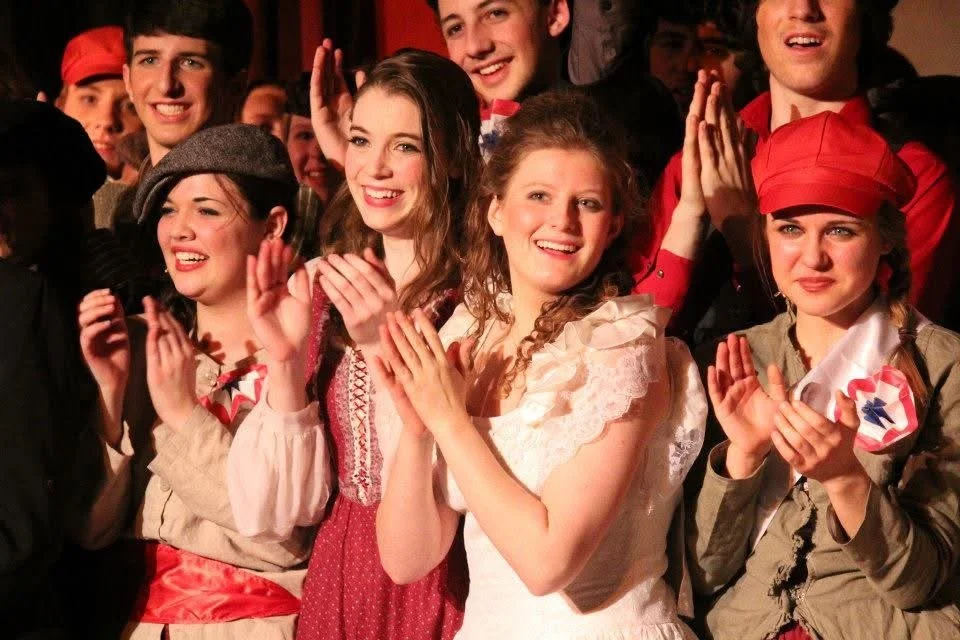
I sang in choirs, musicals and competitions and had the great advantage of having adults in my life who instilled the fear and love of vocal health in me. Even when directors or others asked me to do things beyond what my voice was physiologically ready for, I had people in my life who advocated for my voice and the longevity of my career.
From a young age I became aware of the incredible feats performers were asked to do with their voices. Actors are asked to alter and manipulate their voices to become another person, and they need to project - sometimes without a microphone - and be heard and understood across an auditorium (or even outdoors). They have long rehearsals, and may have to do shows more than once in a day. Musical theater performers add in the dimension of singing difficult repertoire, often while dancing at the same time. I watched as young performers (as well as older and more experienced ones too!) injured their bodies and voices in ways that would affect their career for the rest of their life. After watching an incredibly talented peer of mine develop a voice disorder from long rehearsals, poorly guided technique, and being cast in a role far out of their vocal range my love and passion for vocal health increased. In my senior year of high school I wrote a 70-page manual on vocal health entitled A Student Guide to Vocal Health, gave a series of lectures to fellow performers and performed an accompanying hour-long recital of operatic and musical theater pieces.
When I went off to college I knew I wanted to work with singers and actors and help them to be able to use their voices for the rest of their lives, but I wasn’t totally sure of who did that or what paths I would need to take to learn what I wanted to learn. I entered my undergraduate studies as a music major studying classical voice (often, classical singing and opera is the only way to study voice at a collegiate level). After my freshman year of college I received a special scholarship for the rest of my degree program called the Hannay Vocal Honors Award which allowed me to take two voice lessons a week. I used one lesson to explore my own classical technique and the repertoire I needed to graduate. The other weekly lesson was used to study vocal pedagogy, body mapping and Alexander Technique with a second teacher. I spent my summers attending vocal pedagogy conferences and learning all I could about how to teach voice.
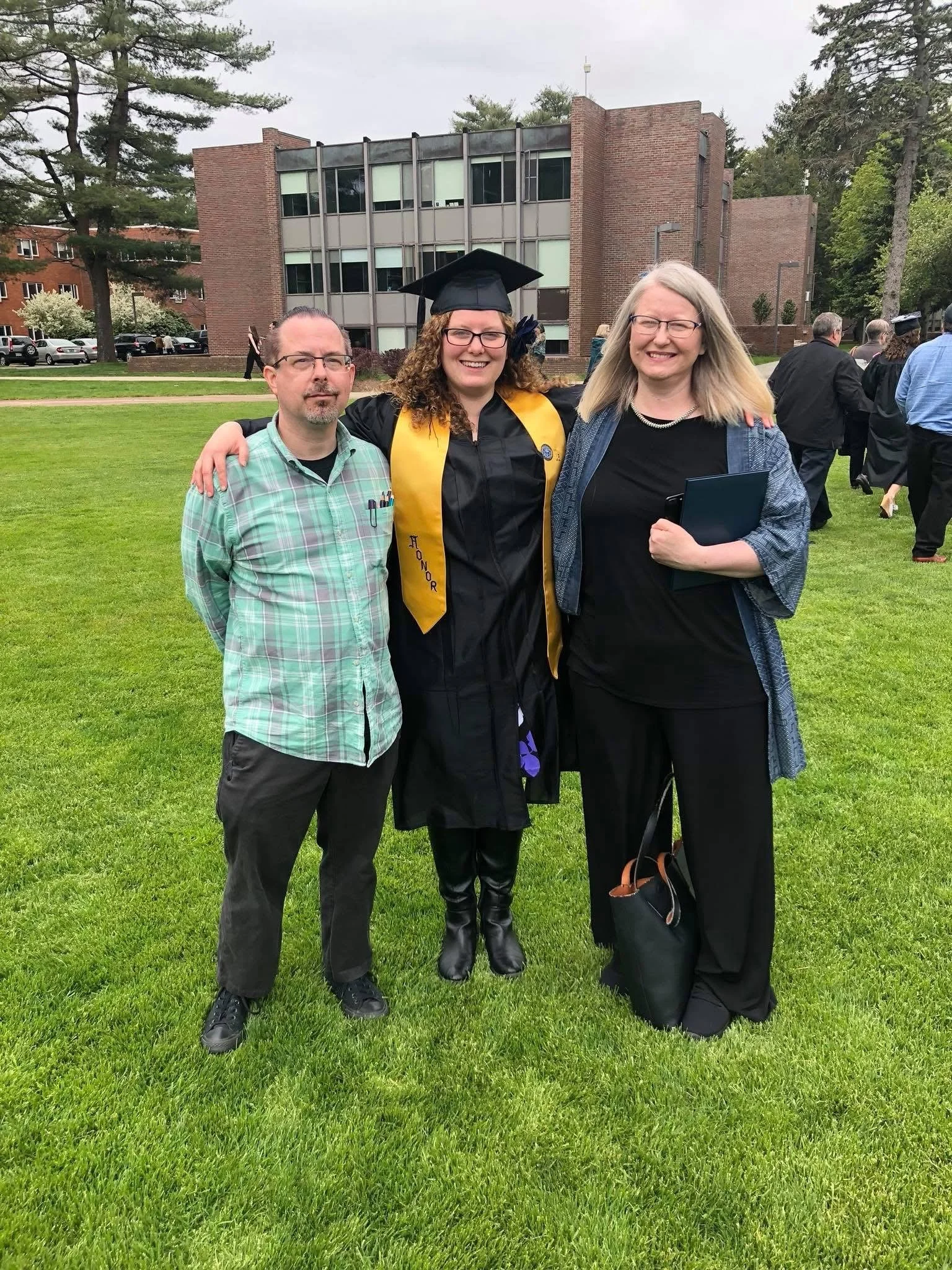
I designed my own special course of study which was effectively a voice science degree.
I graduated Summa Cum Laude and a Phi Alpha Chi scholar (Gordon College’s honors society for the recognition of creativity and scholarly research) with degrees in Music, Linguistics and a minor in Speech Language Pathology. I was the teacher’s assistant for courses in Anatomy and Physiology of Speech and Hearing Mechanism, Phonetics and Phonology, and Scientific Enterprise. My junior year I performed a recital titled A Voyage Through Musical Theater exploring the history and techniques of musical theater repertoire from Gilbert and Sullivan operettas to the 2010s. Then in my senior year I was the first in Gordon College history to graduate with the distinction of honors from the music department. To gain this distinction I wrote an honors thesis on The Intersection of Voice Science and Vocal Pedagogy in Western Practice and performed a lecture recital entitled A Brief History of Vocal Pedagogy based on that same research. Throughout that process I was able to meet and work with Dr. Ian Howell at New England Conservatory, Ken and Joanne Bozeman, Mary Montgomery Klimek at the Estill Voice International and more. I was very fortunate to be hired by them to work at various workshops they gave in 2018 and 2019. It was also during the work on my thesis that I became familiar with Dr. Titze’s research and the field of Vocology.
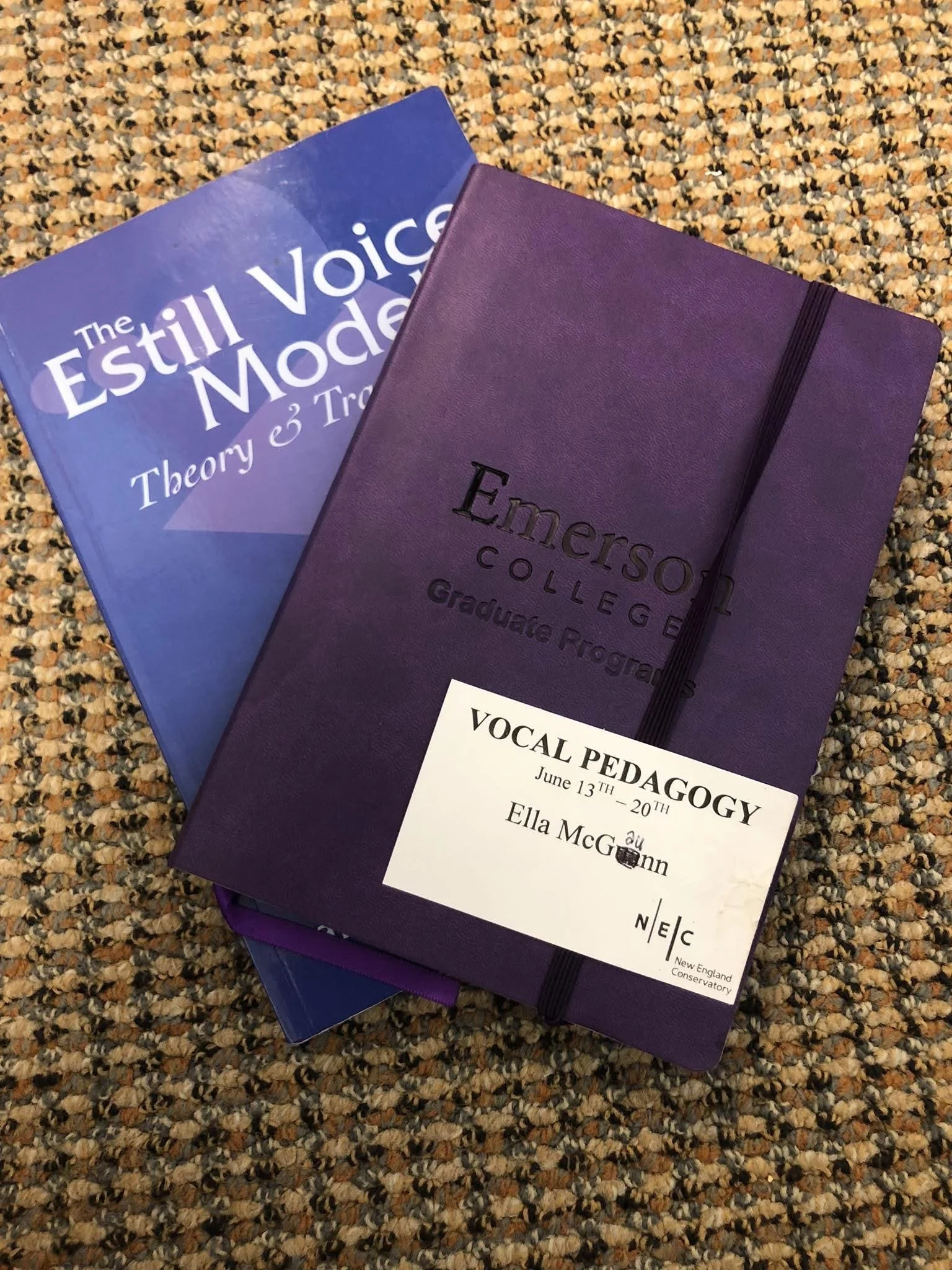
In my undergraduate studies I was encouraged to look into the field of speech language pathology as a way to work with singers in a hospital/medical setting and to be able to accept insurance.
After graduating I received a fellowship to study Speech Language Pathology (SLP) at Emerson, but upon arrival I found that in the entire master’s degree I would only be able to take a single class on voice.
I was shocked to learn that the duties and responsibilities of SLPs had increased so much over time that little to none of the education SLPs receive is in voice. This gap is an ongoing issue in the field and a frequent point of conversation with the American Speech and Hearing Association (ASHA). Speech Language Pathology is a huge field and those who study it need to become experts in a whole range of skills from childhood speech disorders to helping someone relearn how to swallow after a stroke. I have a great appreciation for what SLPs do and the amazing work a voice SLP can do with a singer with an active voice disorder, but I also learned about the limitations of what can be done under insurance and in a hospital setting. SLPs work to rehabilitate voices, but the question is: who serves a singer that doesn’t have a clinically disordered voice, but still needs more help to perform the amazing tasks they are asked to do?
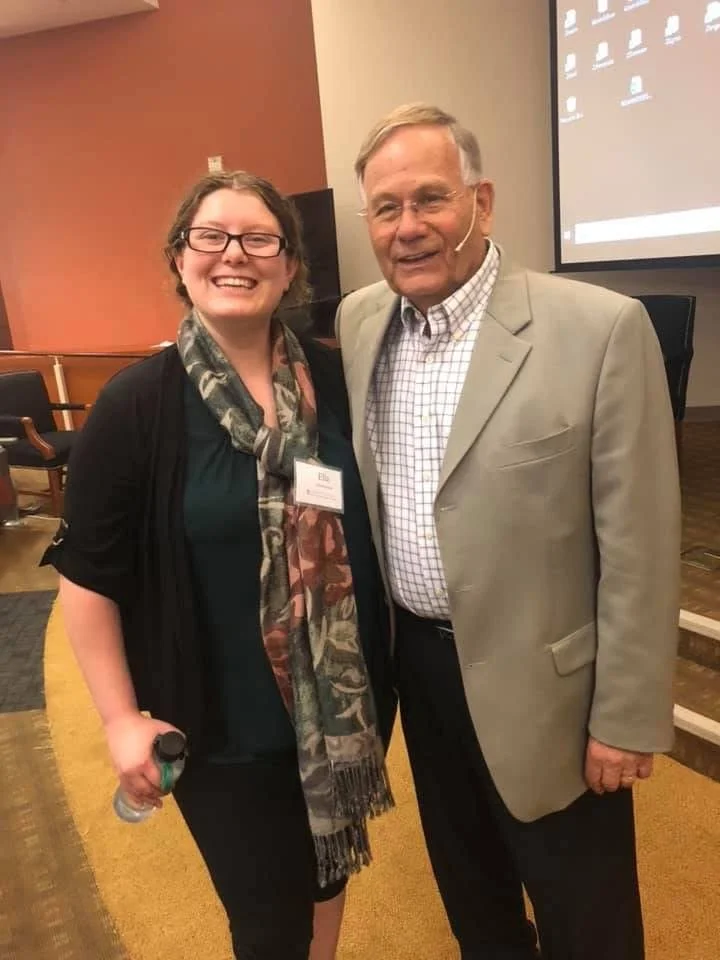
That gap in vocal care would become my life’s work.
After a semester I left the program to continue to pursue my vocal education. I took graduate classes at Shenandoah Conservatory’s Contemporary Commercial Music (CCM) Institute to learn how to work with pop/rock/folk/jazz/country/R&B/musical theater and even screamo singers. At the CCM Institute I got to work with Matt Edwards, Wendy LeBorgne, Marci Rosenberg and meet a man I had long admired - Dr. Ingo Titze - the founder of the field of Vocology.
A couple of years and a pandemic later I had the supreme pleasure of getting my graduate certificate in Vocology (the study of voice science) at the Summer Vocology Institute out of the University of Utah. During my time there I studied The Principles of Voice Production with Dr. Titze, Motor Learning with Kittie Verdolini Abbott, theater voice with Kate Devore and more.
Every year I continue my vocal education and build my toolbox of strategies for my clients.
Examples of my continuing education in recent years include: studying myofascial release with Jen Mast, Alexander Technique with Debi Coco, and Linklader Voice and Shakespearean performance practices with Shakespeare & Company. Right now (Fall of 2026) I’m brushing up on some dialectical work with Paul Meier and taking a few voice lessons myself. I hope to never stop growing and thinking outside of the box for my clients. Voice science is always evolving and every person has different goals for what they want to do with their voice. I can’t wait to continue learning and growing for my clients. It’s a field with no one pathway to finding mastery, but I continue to find encouragement and inspiration from the many voice teachers, body work practioners, voice scientists and medical professionals who have come before me. It is an honor to work alongside many different kinds of specialists in one part of a voice user’s journey.

Singing Masks
I’m a singing teacher who has tried just about every mask for singing singing on the market -here’s what I’ve found
I tried 10 different masks for singing (some marketed towards singers and some not) and here’s what I found:
First off- I am not an affiliate of any of these companies- I am just a voice teacher who is passionate about vocal health and accessibility. With that said- every singing mask has different benefits and drawbacks to them and trying them all out can get expensive- so I did that part for you. I tested each of these masks for:
What I tested for:
Comfort
Resonance
Price
Fit
Protection
Customer Service and Speed
Here are the masks that I tested:
Surgical Mask (Can be found online or in drugstore/grocery store)
KN95 Mask (Can be found online or in drugstore/grocery store)
3-D Fabric Masks (Amazon Link) —-> Approx. $4 a mask
Broadway Relief Singer’s Mask https://www.broadwayreliefproject.com/singersmask ——> Approx. $25/mask
Singer’s Mask on Amazon (click here) ——> Approx. $22/mask
TMF Singer’s Mask (NATS Choice) https://stores.inksoft.com/nats/shop/home ——> Approx. $10-$15/mask
Midura Design’s Singer’s Mask https://miduradesigns.com/3d%2Fsinger-mask-shop —-> Approx. $15/mask
DCBL Mask (Marketed toward Speakers) https://www.dcblmasks.com/ —-> Approx. $15-$20/mask
Mask extender (Amazon Link) —-> Approx. $8 per pack of 10
Plastic 3-D Frame for Mask (Amazon Link) —-> Approx. $10 per pack of 10
Too Long Didn’t Read Version (TLDR) My top choice is DCBL X-1 Mask https://www.dcblmasks.com/
They are a little pricey ($15-$20 per mask), but they are the most comfortable, best protection and best resonance in my opinion. I also can breathe really easily in them without problem. If you are able to invest I’d suggest buying a few of these to switch between when one is in the wash. Also a great options for teachers or other voice users. Everyone has different bone structure and preferences so I’ve included what I like and dislike about the other mask options.
I’m going to rank my top picks for each category and then elaborate a little on each option.
Comfort
DCBL X-1 Mask
Midura Design
3-D Mask
Mask Extender and/or 3-D Frame can really help make any mask more comfortable
Least Comfortable: Broadway Relief Project Singer’s Mask
Resonance
DCBL X-1 Mask
TMF Mask
Broadway Relief Mask
Worst Resonance: Surgical Mask without extender or frame
Price
Fabric mask or surgical mask with extender and frame (trade off: some comfort- especially jaw tension)
TMF Singer’s Mask (trade off: worse customer service and longest wait time)
Most Expensive: Broadway Singer’s Relief
Fit (somewhat depends on face shape)
DCBL Mask (somewhat adjustable)
Midura mask (comes in different sizes)
TMF (comes in different sizes)
Protection
DCBL X-1 Mask
KN95 (Trade off in resonance)
TMF Mask
Least Protection: Any mask that does not fit you! You should have a seal around your whole mouth! Always check fit for your masks! And make sure you can move your jaw without it falling off! Also look for layers! Is it single layer or 3 layer? If it’s reusable how easy is it to wash? Will you be able to regularly wash it or “quarantine” it between washes?
Customer Service and Speed
DCBL X-1 Mask
3-D Fabric Masks
Broadway Relief Mask
Worst Customer Service: TMF- it took months to receive my masks, and even then my order was wrong.
Surgical Mask (Can be found online or in drugstore/grocery store)
This is the one most of us are accustomed to using
Benefit: easily accessible and inexpensive, also disposable
Downsides: hard to move jaw and lips, not best resonance, tends to collapse when inhaling, neck tension
Ways you can make this better: use a mask extender and/or 3-D Frame. They are inexpensive, reusable and can be paired with any mask for more room to room, less inhalation collapsing and to try to reduce neck/jaw tension.
2. KN95 Mask (Can be found online or in drugstore/grocery store)
This provides the most safety and is fairly accessible
Not great for resonance, BUT you could pair this with a microphone to amplify your sound
3. 3-D Fabric Masks (Amazon Link) —-> Approx. $4 a mask
This does not have the most protection, but it is definitely one of the most cost effective options
Just make sure it fits you properly
You can also pair this with the 3-D frame and mask extender
4. Broadway Relief Singer’s Mask https://www.broadwayreliefproject.com/singersmask ——> Approx. $25/mask
Honestly this one is my least favorite for the following reasons:
Most expensive
Clunky and painful (hard wire rim)
Gets incredibly hot while you are singing
Not as good resonance as the others
5. Singer’s Mask on Amazon (click here) ——> Approx. $22/mask
This mask is okay and fine in a pinch
Not the best fit or protection
6. TMF Singer’s Mask (NATS Choice) https://stores.inksoft.com/nats/shop/home ——> Approx. $10-$15/mask
This mask was cited in a study as being one of the better singer’s masks on the marker (protection wise)
It is one of the most cost effective solutions
Fit and comfort are good
The resonance is fair
My customer service experience was appalling. It took months for me to receive my order- and when I got it the order was wrong. I still have not been refunded or sent the corrected masks I was promised two months ago. I would not recommend them for that reason.
7. Midura Design’s Singer’s Mask https://miduradesigns.com/3d%2Fsinger-mask-shop —-> Approx. $15/mask
Pretty good design and sound
There’s so nose bar to help with glasses not getting fogged up (but that might be something you like)
Easy to breathe, but the frame tends to collapse during deep inhales
Different sizes is a nice feature, helps with fit
8. DCBL Mask (Marketed toward Speakers) https://www.dcblmasks.com/ —-> Approx. $15-$20/mask
This is my top pick in just about every area
The customer service is great, the fit is perfect, there is 3-layer protection and easy washing.
Soft and comfortable
Best resonance in any of the masks
One of the only singer’s masks that don’t make you look like a duck
9. Mask extender (Amazon Link) —-> Approx. $8 per pack of 10
Great option for people who don’t like mask behind the ears
Great option for people dealing with tension in neck/jaw from masks
10. Plastic 3-D Frame for Mask (Amazon Link) —-> Approx. $10 per pack of 10
inexpensive option to help with mask collapsing during inhalation